Current Pillar Journal
And the Word became flesh and lived among us, and we have seen his glory, the glory as of a father’s only son, full of grace and truth.
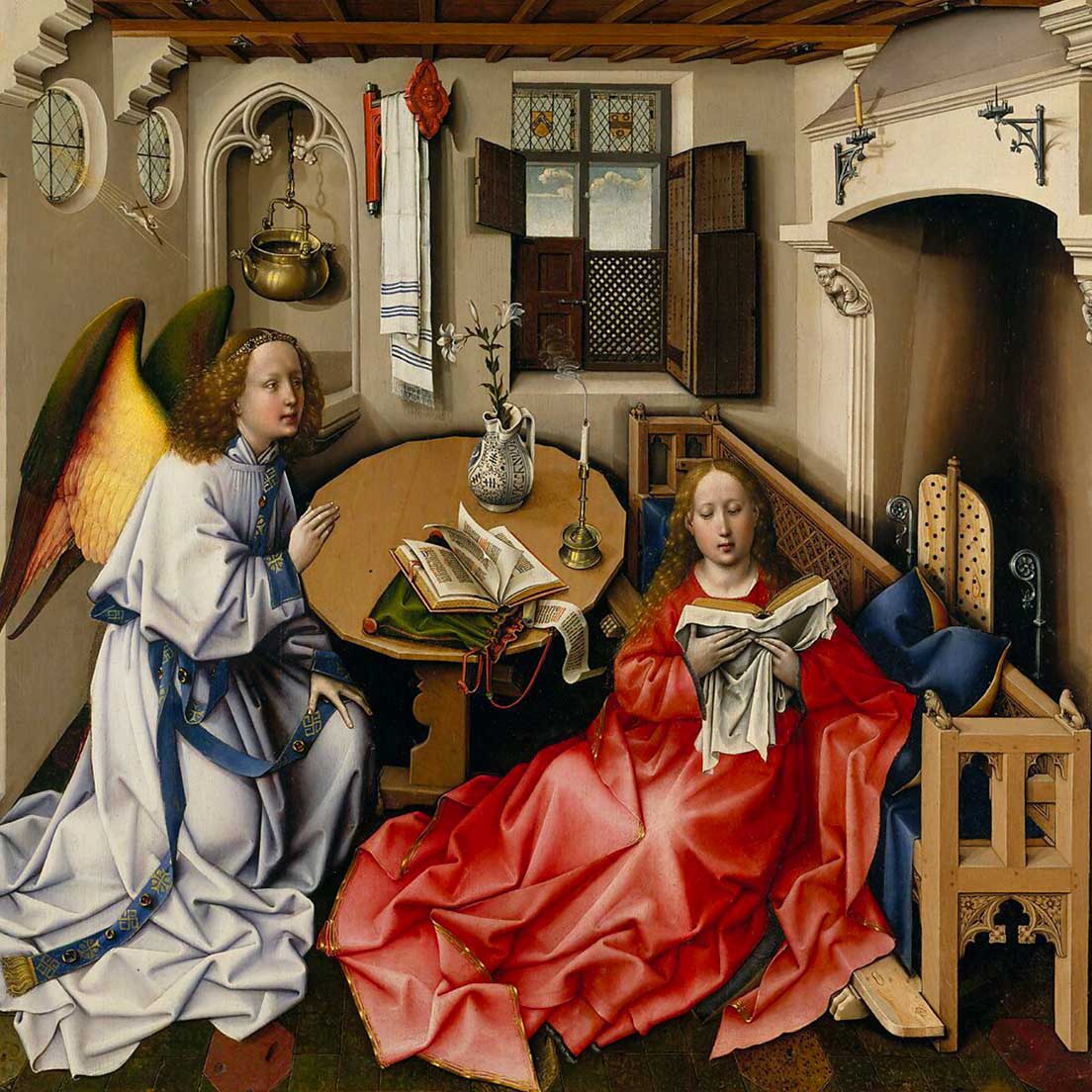
Consider this center image from a triptych of the Annunciation, painted by Robert Campin Netherlandish ca. 1427–32, on view at the Met Cloisters, NYC.
When you look closely at the top left corner of the painting, you’ll see the tiny, embryonic baby Jesus, already carrying a cross, making his way through the sunbeam toward Mary’s womb. The artist provides a tangible visual for the indescrib- able moment when Mary discovered she was not just “with child,” but also “with God,” bearing God in her womb.
What a pregnancy announcement. If you’ve spent time waiting and longing for two pink lines on a pregnancy test (I’m with you), or grieving the death of a baby who died too soon (I’m so sorry, there are no words), or waiting eagerly for the child in your womb to grow healthily and be born into the world (thanks be to God!)… then perhaps you can relate to Mary’s sensitive embodied reality in this moment– and the wave of emotions she must have been experiencing alongside it all. A tiny embryo, a small human person, perhaps the size of a raspberry or a blueberry, was waiting, growing, and changing in tender vulnerability in her womb, carrying the Hope of the world in his very Self.
In the midst of her wondering, questions, and simultaneous faithful willingness, the angel Gabriel insisted to Mary the personal assurance that “no Word from God will ever fail” (Luke 1:37), an anchor point for the months ahead of carrying the developing God-Man within her.
The cross on the back of the tiny Christ child contributes to the theological intensity of the Annunciation scene. Not only was Mary bearing God within her, the Word-from-God made flesh– she was bearing the self-giving God, the God who would die, the God who would be crucified for her and for the whole world. From conception, and from eternity, the Son has chosen to be this God for us… the God who would give himself in total love on the cross so that Mary, and everyone, could be trans- formed by Love.
Here’s what the transformation could be like: because of him, we can become our truest selves, our child-of-God selves.
John 1:12
But whoever did want him,
who believed he was who he claimed
and would do what he said,
He made to be their true selves,
their child-of-God selves.
Eugene Peterson’s rendering of John 1:12 in the Message
paraphrase captivates me. I so deeply want God to make me my
true self– don’t you?
Eugene Peterson’s rendering of John 1:12 in the Message paraphrase captivates me. I so deeply want God to make me my true self– don’t you?
The old self, the false self, the distorted self… that self rears her head in my life far more often than I’d like. That’s the self who judges others, the self who holds on to bitterness, the self who sinks into insecurity rather than rising up to God’s purposes for me. But I want Him– Jesus. I want God-the-Word to do what He said he would do in my life. I want the Word-made-flesh who bore the cross from Gestation Day 1 to show up in such a way, to transform me so deeply, that I could say, with the angel: “no Word from God will ever fail.”
But whoever did want him,
who believed he was who he claimed
and would do what he said,
He made to be their true selves,
their child-of-God selves.
I’m struck by the past-tense grammar of John’s language. According to the gospel writer, this “re-making” of me and you (if you want Jesus) has already happened. Because Jesus did what he said he would do and is who he claimed to be, the transformation has already been unfolding in us… old has gone, the new has come (2 Cor 5:17).
But I don’t feel and act totally new. Paul in Romans 7 gives voice to my own heart, with all his regret and sense of inadequacy: ”I do not understand what I do. For what I want to do I do not do, but what I hate I do” (Romans 7:15).
Here’s the good news: “in the midst of our very human selfishness, the waylaying love of God has broken through to us
unconditionally” (Fleming Rutledge, Advent). The transforming love of God is ultimately unconditional, not deterred by our failings and sorrows. God has broken through to us, and will continue to break through to us, here and now.
The Word made his dwelling among us– in the midst of our very human selfishness. “The Word became flesh and blood, and moved into the neighborhood” (John 1:14, MSG), bearing a cross from the start. It’s a lot to wrap our heads and hearts around. The embryonic cross-carrying Christ shows us that we were never going to save ourselves. We were always going to need him. And he was always intending to be the Word who would come up close to us in our neighborhood, to see us, know us, and save us quite personally.
So this Advent, we turn to him again with all our longings, all our weaknesses, all our unfinished business, even our frustrations, anger, and confusion. We lay it before the Word-made- flesh for us and for our salvation, trusting that the forgiveness found in the Cross of Christ is, and always will be, the truest Word for us.
God was never asking us to clean up our own mess. God was never asking us to pull it together and figure it out. God simply asks us to wait for him again. Karl Barth wrote, “What other time or season can or will the Church ever have but that of Advent?”
Tish Harrison Warren puts it this way: “Our Christian life is a long practice in waiting– waiting for God to meet us, to grow us, to save us. And ultimately, waiting for Jesus to set all things right.”
Written by Anna Anderson
WEEK 4 INTERIORIZATION
Read it over and over again. Make notes.
Write it out. Draw Pictures. Get it inside.
And the Word became flesh and lived among us,
and we have seen his glory, the glory as of a father’s only son,
full of grace and truth.
John testified to him and cried out,
‘This was he of whom I said,
“He who comes after me ranks ahead of me
because he was before me.”’
From his fullness
we have all received,
grace upon grace.
Conversation Question for Children and Families:
Jesus gives us so many good gifts. What is one thing you are thankful to God for today?