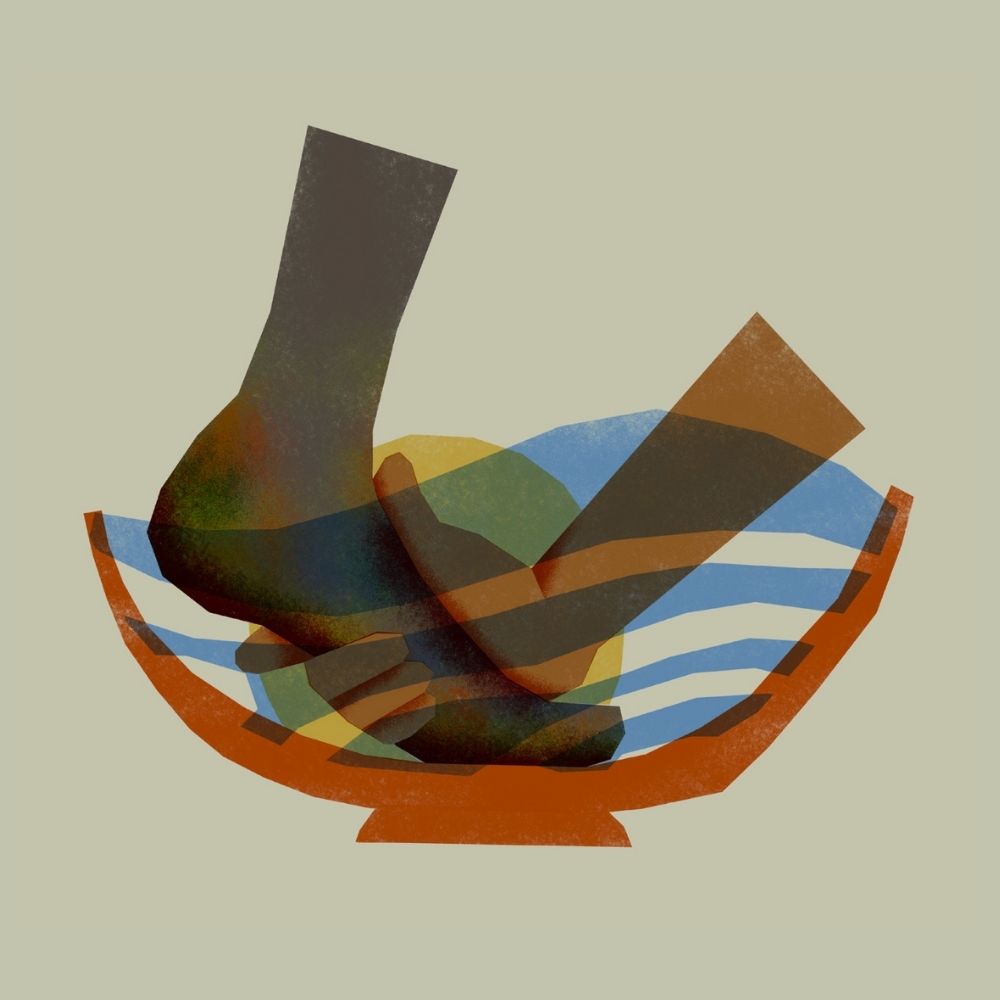
So they took Jesus, and carrying the cross by himself he went out to what is called the Place of the Skull, which in Hebrew is called Golgotha. There they crucified him and with him two others, one on either side, with Jesus between them. Pilate also had an inscription written and put on the cross. It read, “Jesus of Nazareth, the King of the Jews.” Many of the Jews read this inscription because the place where Jesus was crucified was near the city, and it was written in Hebrew, in Latin, and in Greek. Then the chief priests of the Jews said to Pilate, “Do not write, ‘The King of the Jews,’ but, ‘This man said, I am King of the Jews.’ ”Pilate answered, “What I have written I have written.” When the soldiers had crucified Jesus, they took his clothes and divided them into four parts, one for each soldier. They also took his tunic; now the tunic was seamless, woven in one piece from the top. So they said to one another, “Let us not tear it but cast lots for it to see who will get it.” This was to fulfill what the scripture says, “They divided my clothes among themselves, and for my clothing they cast lots.”And that is what the soldiers did. Meanwhile, standing near the cross of Jesus were his mother, and his mother’s sister, Mary the wife of Clopas, and Mary Magdalene. When Jesus saw his mother and the disciple whom he loved standing beside her, he said to his mother, “Woman, here is your son.” Then he said to the disciple, “Here is your mother.” And from that hour the disciple took her into his own home.After this, when Jesus knew that all was now finished, he said (in order to fulfill the scripture), “I am thirsty.” A jar full of sour wine was standing there. So they put a sponge full of the wine on a branch of hyssop and held it to his mouth. When Jesus had received the wine, he said, “It is finished.” Then he bowed his head and gave up his spirit.Since it was the day of Preparation, the Jews did not want the bodies left on the cross during the Sabbath, especially because that Sabbath was a day of great solemnity. So they asked Pilate to have the legs of the crucified men broken and the bodies removed. Then the soldiers came and broke the legs of the first and of the other who had been crucified with him. But when they came to Jesus and saw that he was already dead, they did not break his legs. Instead, one of the soldiers pierced his side with a spear, and at once blood and water came out. (He who saw this has testified so that you also may believe. His testimony is true, and he knows that he tells the truth, so that you also may continue to believe.) These things occurred so that the scripture might be fulfilled, “None of his bones shall be broken.” And again another passage of scripture says, “They will look on the one whom they have pierced.” John 29:16b-37
Questions for Reflection:
- With this story guiding your heart and mind to the heart and mind of Christ, what does it share with you about who Christ is (attributes, actions and promises)?
- With this story guiding your heart and mind to the heart and mind of Christ, what does it share with you about who you are or could be (identify sins or virtues)?
- With this story guiding your heart and mind to the heart and mind of Christ, what does it prompt you to confess?
- With this story guiding your heart and mind to the heart and mind of Christ, how does it prompt you to pray (for yourself and for others)?
Prayer for Holy Week:
Almighty and everliving God, in your tender love for the human race you sent your Son our Savior Jesus Christ to take upon him our nature, and to suffer death upon the cross, giving us the example of his great humility: Mercifully grant that we may walk in the way of his suffering, and also share in his resurrection; through Jesus Christ our Lord, who lives and reigns with you and the Holy Spirit, one God, for ever and ever. Amen.
Invitation to Fasting:
We all experience the deep ache that the world is not as it should be. We are not as we should be. In Christian tradition we call being honest about the pain of the world with God lament. Fasting goes hand in hand with lament because it can give our bodies a way to participate in grief, longing, and protest before God. By not participating in whatever it is we have chosen to fast from, we make space to acknowledge that something is not right. We acknowledge and spend time with pain and refuse to quickly cover it up with comfort. In Scripture, God’s people often fasted in times of sorrow or injustice, using hunger as a cry for God’s intervention rather than an attempt to fix things themselves. Fasting as lament holds our ache honestly before God, trusting that God hears, grieves with us, and is at work even when relief has not yet come in the ways we might imagine it would.